Most tower-defense games hand you a fixed track and ask where to put your towers. Mazing flips that. The towers are the track. You place them as walls, and the path bends around whatever you build. Master that and you stop playing the level the designer drew and start drawing your own. This is the mechanic that separates the genre's deepest games from its clickers, and this guide covers all of it: what it is, where it came from, the shapes that work, and the rules that keep it honest.
#What mazing is
Mazing is placing towers so that they act as walls, forcing creeps to walk the longest possible route through your killing ground instead of a straight line to the exit. Creeps pathfind around solid towers toward the goal. Every tower you drop that blocks the shortest route adds distance, and distance is time, and time in range is damage.
The single number that matters is time-on-target: how long each creep stays inside your towers' range. A creep that crosses the board in a straight line spends two seconds getting shot. Fold that same board into a tight switchback and the creep spends twelve seconds getting shot by the same towers, from both sides, with no extra gold spent. Everything else in mazing serves that one goal: buy the longest path in the smallest area, then line it with as much damage as it will hold.
This is why mazing rewards spatial thinking in a way lane-only tower-defense never does. On a fixed track, a stronger tower is always better. In a maze, tower placement can double your effective damage before you have upgraded anything. Two players with identical gold and identical towers can post wildly different results purely on how they folded the path.
#A short history
Two lineages made mazing mainstream, and they went in opposite directions.
The mass-market one is Desktop Tower Defense, a Flash game by Paul Preece that took off in 2007. It gave you an open field instead of a track and let you place towers anywhere, so the path formed itself around your build. Millions of people learned mazing there without ever hearing the word, discovering on their own that a clever U-turn beat a wall of expensive turrets. It is the reason a whole generation associates "maze tower defense" with a browser tab and a lunch break.
The competitive lineage came out of Warcraft 3 custom maps. Wintermaul, Wintermaul Wars, Element TD, Gem TD, and the tower-wars family took the same open-field placement and pointed it at other people. Now you were not just mazing to survive a script. You were mazing under pressure from a live opponent who was actively sending creeps to break your maze while you tried to break theirs. That versus context is where mazing turned from a survival puzzle into a duel. For the full story of that thread, see the history of Wintermaul Wars.
Both branches still feed the genre today. The solo, survive-the-waves side runs through games like Element TD 2 and Emberward. The versus, send-creeps-at-a-human side is the one Maul Tactics picks up, and it is the harder, more interesting problem, because your maze has to hold against an attacker who gets a vote.
#The core maze patterns
There are only a handful of shapes worth knowing, and once you see them you will spot them in every maze anyone builds. Each one trades path length against something else, so which one wins depends on your board and your towers.
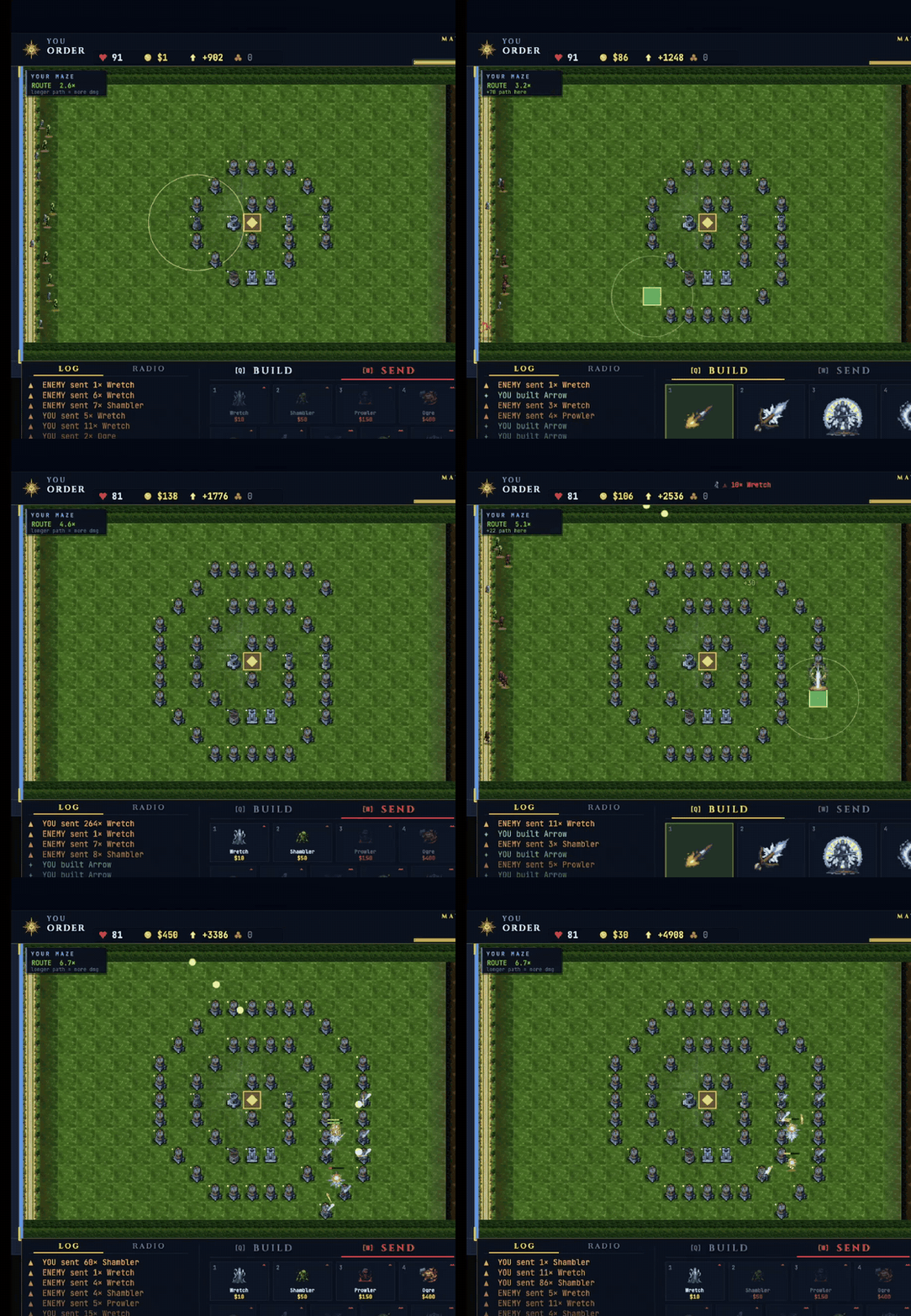
Serpentine
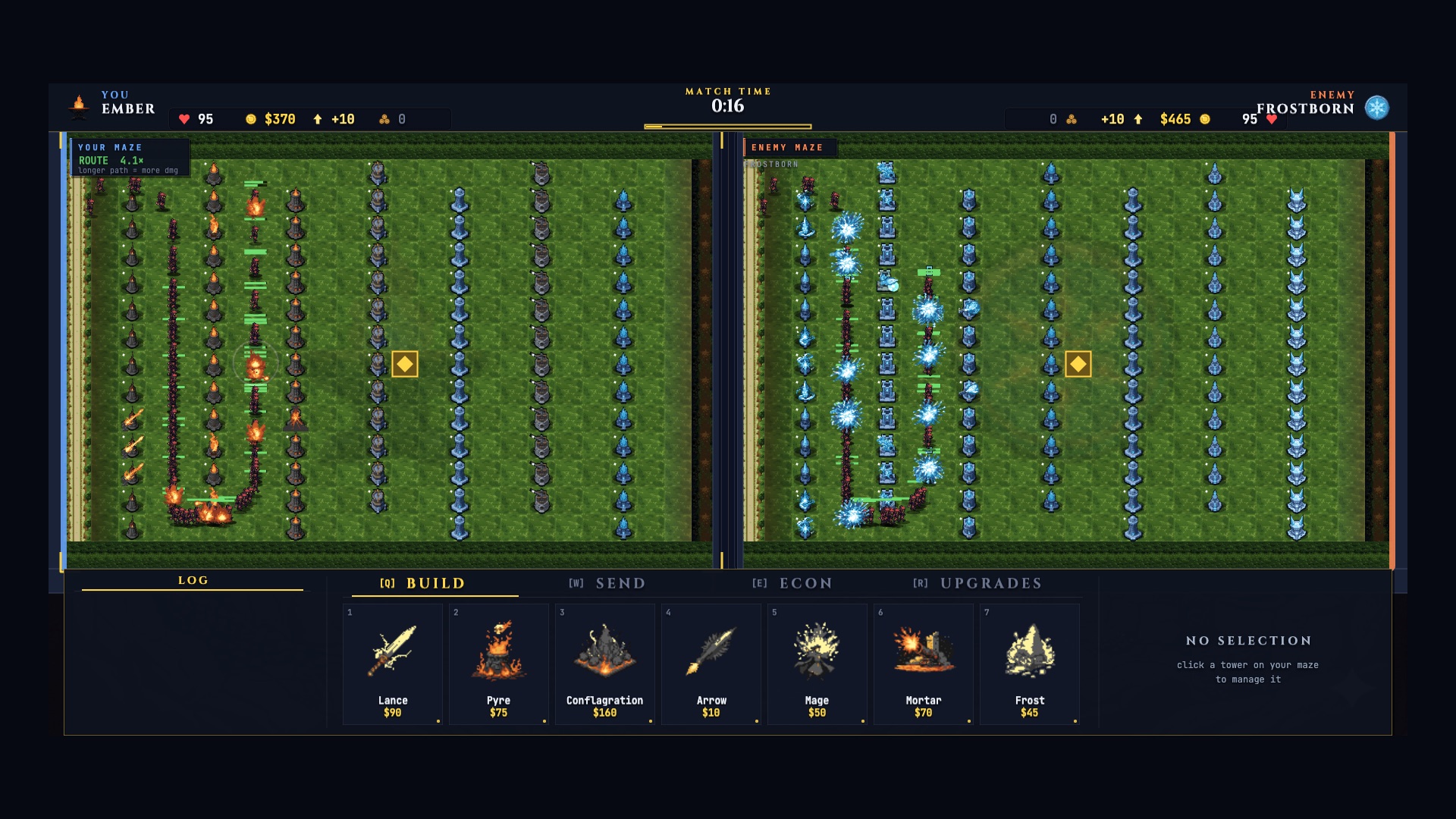
The serpentine (or switchback) is the workhorse. You build parallel walls that force the path to run down one lane, hairpin, run back up the next, hairpin again, and so on. It is the most path-length per tile of any pattern, which is why it is the default. Every creep walks the full accordion, and because the lanes sit right next to each other, a tower placed on a wall shoots into two or three lanes at once. If you only learn one shape, learn this one.
Comb
The comb runs one long spine down the board with teeth sticking off it, so the path weaves in and out of each tooth. It is slightly less efficient on raw length than a tight serpentine, but it exposes the path to more surrounding tiles, which makes it strong for splash and area towers that want to hit a cluster of creeps bunched at a turn. Reach for the comb when your damage is area-of-effect rather than single-target.
Zigzag
The zigzag is the fast, forgiving pattern: diagonal offsets that push the path back and forth without full hairpins. It builds quicker and is much harder to accidentally seal off, so it is what you throw down when you are short on time, short on gold, or defending a wave you did not see coming. It gives up some length compared to a serpentine, but a rough zigzag beats a half-finished perfect maze every time.
Spiral
The spiral winds the path inward toward a center, then back out, or dead-ends creeps at a single killing core. It packs enormous length into a compact square, which is ideal when your buildable area is small or oddly shaped. The catch is that it is the fiddliest to build and the easiest to wall shut by mistake, so it rewards players who already have the anti-block line memorized.
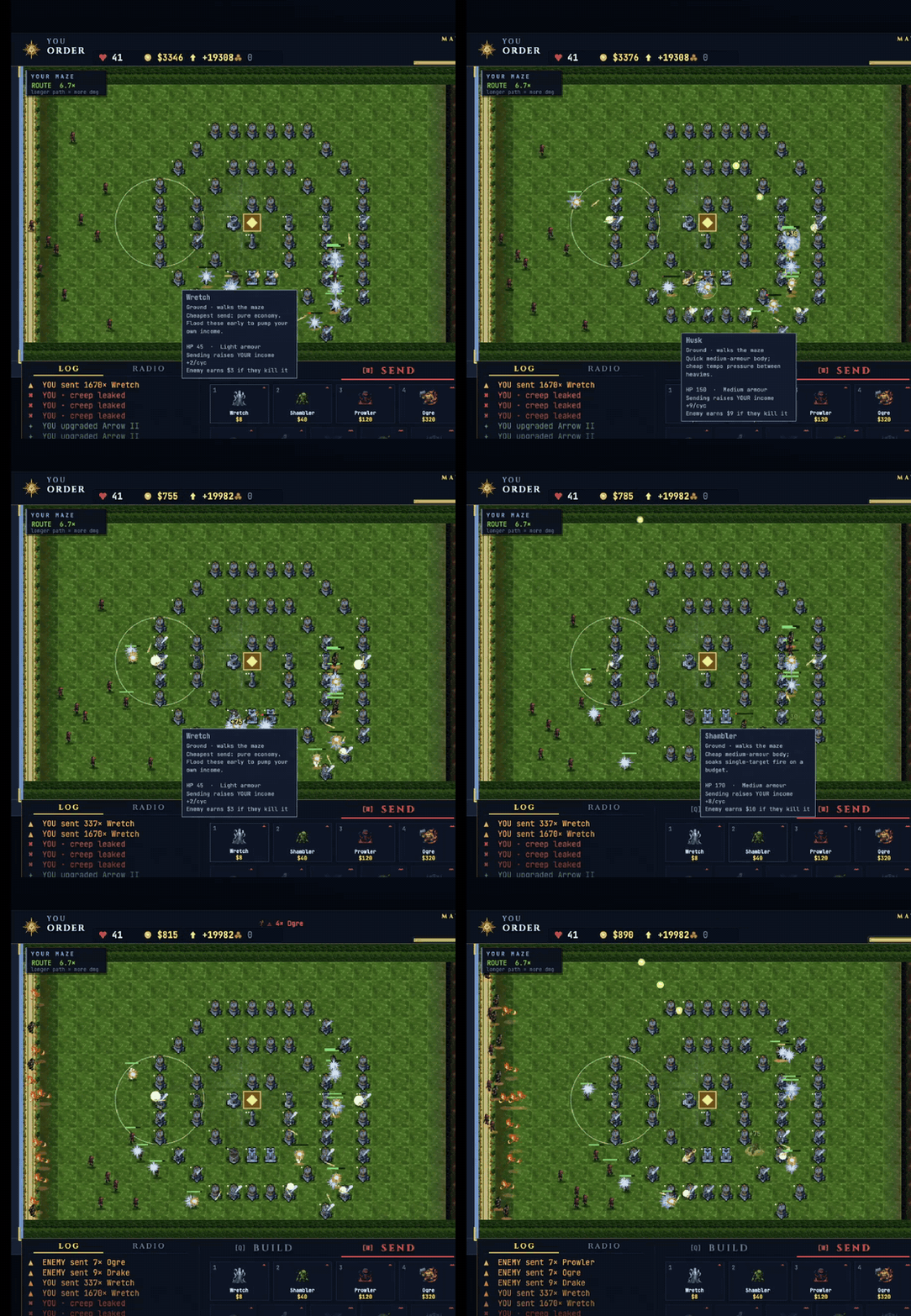
#Chokepoints and kill-boxes
Length is only half the maze. The other half is where you concentrate the damage. The best real estate in any maze is where the path doubles back on itself, because a tower sitting in that pocket fires into the path twice: once as creeps go in, once as they come out. A single tower wedged in a hairpin can out-damage two towers spread along a straight run.
A chokepoint is a spot where the path narrows so every creep in the wave has to file through the same tiles. A kill-box is a chokepoint you have ringed with towers so that the whole wave gets ground down in one small square. When you build a serpentine, the tiles between two adjacent lanes are the prime kill-box real estate, because a tower there covers both lanes plus the hairpin that joins them. Put your strongest single-target towers on those tiles and your slows and splashes where creeps bunch up entering a turn.
The practical rule: do not spread damage evenly along the whole path. Concentrate it. A wave that survives your first kill-box is going to leak, so you want it dead before it clears the pocket, not slowly chipped over the full length. Overlap ranges so a creep is never out of range of at least two towers while it is inside a turn.
#Juggling
Juggling is the most argued-about technique in mazing, so here is exactly what it is. You build a maze with two possible exits and a single wall that decides which one is open. When creeps commit to walking toward the open exit, you sell that one wall tile and rebuild it on the other side, flipping which exit is open. The pathfinder recalculates, the creeps turn around, and they retrace the maze they already walked. Do it repeatedly and a wave walks the same corridor several times over, taking your towers' fire on every pass, for the price of selling and rebuilding one tower.
It is powerful because it multiplies time-on-target far past what a static maze can. It is also divisive, and honestly so. One camp calls it a degenerate exploit that turns a building game into a click-timing minigame and makes waves trivial. The other camp calls it legitimate advanced play, a real skill with a real cost in attention and gold. Both have a point. What actually settles it is the game: many maze tower-defenses deliberately limit juggling, whether by charging a sell penalty, adding a build cooldown, or leaning on the anti-block rules below so you cannot cheaply flip the path. If you are learning, know the technique exists and know that whether it is fair depends entirely on the ruleset you are playing under.
#Anti-block
Anti-block is the rule that keeps mazing a puzzle instead of a wall-building exercise. The temptation, once you understand that towers block the path, is obvious: just seal the exit completely and creeps can never reach it. Anti-block stops that. If a placement would fully wall off the goal, the game refuses the placement, or it lets creeps path straight through your weakest tower as if it were open ground. Either way, you are never allowed to build a maze with no way out.
This is not a limitation to resent. It is the constraint that makes the whole mechanic interesting. Because you must always leave a legal route, the game becomes about making that mandatory route as long and as punishing as possible. The best mazers build right up to the anti-block line: they add wall after wall, each one forcing a longer detour, stopping one tile short of the placement that would seal the exit. Learning where that line sits on your board, and building tight against it, is the difference between a maze that adds a little length and one that folds the whole field into your kill-box.
#Mazing under pressure
Everything above is true of solo mazing against scripted waves. Versus play adds a second clock, and this is where the mechanic gets genuinely hard. In a 1v1 maze tower-defense, you are not just holding against a wave the game spawns. A live opponent is sending creeps at you, and every creep they send you did double duty: it raised their income and it forced you to spend on defense. Your maze is now an economy clock as much as a wall.
The tension is constant. Gold spent on towers is gold not spent on sends, and gold spent on sends is pressure that forces the opponent to over-invest in their maze instead of racing you on income. A maze that would comfortably survive scripted waves can crumble the instant a human reads it and sends the exact creep type it is weak to. So versus mazing is not just about the longest path. It is about a resilient path: one that holds against fast creeps and tanky creeps and air, one you can reinforce a turn at a time as the pressure ramps, without ever leaving a leak while you rebuild.
This is the loop Maul Tactics is built around: open-field mazing and creep-sending to raise your income and pressure the other player. The full Steam game has 15 races, Story Campaign and online 1v1 or 2–4 player free-for-all. The Steam demo is free, while the browser demo lets you practise solo. If you want to see which maze tower-defenses land the mechanic best across solo and versus, the roundup of the best maze tower-defense games is the companion read.
#Glossary
The tower-defense community has a precise vocabulary for all of this, and using it correctly is half of reading a strategy guide or a match. Here is the genre-level version, defined plainly.
- mazing
- Placing towers as walls to force creeps along the longest legal path through your firing range, maximizing time-on-target. The defining mechanic of this subgenre.
- juggling
- Selling and rebuilding a wall in a two-exit maze to flip which exit is open, forcing creeps to turn around and retrace the maze. Considered an exploit in some rulesets, advanced play in others.
- leak
- A creep that survives your maze and reaches the exit, costing you lives (or income, depending on the game). To "leak" is to let one through. Leaking a wave usually means your maze was too short, too weak, or the wrong shape for that creep type.
- income
- Your recurring gold, the resource that funds towers and sends. In versus games income is the real scoreboard: the player who out-earns and out-mazes usually wins, and the two goals pull against each other.
- sends / sending
- Spending gold to spawn creeps into the opponent's board (versus play). A send raises your own income and pressures their maze at the same time, which is what makes it the central tension of tower-wars games.
- creeps
- The units that walk your maze and that you kill for gold or send at an opponent. Always "creeps" in this genre, never "mobs" or "enemies."
- anti-block
- The rule preventing you from sealing the path completely. If a wall would fully block the exit, the game forbids it or lets creeps path through it, so a legal route always exists.
- builder
- The unit or cursor you use to place and sell towers. In some maze games the builder is a physical piece you move around the board; in others it is just your placement tool.
- full maze
- A maze built out to the anti-block line, using every available tile so the mandatory path is as long as the board allows. The goal state of a good build.
- tower wars
- The competitive subgenre where two or more players maze against each other and send creeps back and forth, as opposed to solo survive-the-waves tower-defense. Wintermaul Wars and its descendants live here.