Almost every custom map you loaded on Battle.net in 2004 died with the server it ran on. A handful did not. A handful outgrew Warcraft 3 entirely, shed the engine that built them, and became games worth billions of dollars and years of other people's lives. This is a family tree of the ones that made the jump, the ones that tried and faded, and the ones still waiting for a translation.
#The World Editor was the most important incubator in gaming
Blizzard shipped Warcraft 3 in 2002 with a full copy of the tools they used to build it. The World Editor was not a level designer bolted on for marketing. It was a real programming environment: a trigger system, a scripting language (JASS), custom units, custom abilities, custom everything. You could rewire the game so thoroughly that the result had nothing to do with orcs and humans. People did exactly that, by the tens of thousands, and traded the results as .w3x files on forums and file hosts.
The important part was distribution. Warcraft 3 hosted custom games natively on Battle.net. You did not download a mod, patch a client, or join a Discord. You opened the custom game list, saw a lobby named something like Green TD Survivor v3.6b, clicked it, and thirty seconds later you were playing a game some teenager wrote in his bedroom. That frictionless path from "I made a thing" to "strangers are playing my thing" is the reason the World Editor minted whole genres and a dozen other modding scenes did not. The tool mattered. The zero-install lobby mattered more.
What follows is not a complete list. It is the lineage that produced standalone games, told as a tree with real branches. Some branches grew into an industry. Some snapped off. One is still, decades later, mostly untranslated.
#DotA to Dota 2, and the shadow it cast on League
The most famous branch is the one everyone already knows, so I will keep it short and point you to the people who told it well. The genre now called the MOBA did not start with DotA. It started with a StarCraft map called Aeon of Strife, which put a lone hero in a lane against waves of AI-controlled units. When Warcraft 3 arrived with its better hero and ability systems, mapmakers rebuilt that idea. The version that stuck was Defense of the Ancients, and the version of that which stuck was DotA Allstars, shepherded for years by a designer known as IceFrog.
Two standalone games grew off this branch. Riot's League of Legends (2009) took the DotA formula, built it on its own free-to-play client, and became one of the largest games on earth. Valve hired IceFrog directly and shipped Dota 2 (2013), a near-literal remake of the map as a first-party product, complete with a tournament (The International) whose prize pools ran into the tens of millions. One custom map. Two of the biggest titles of the following decade. If you want the full history, PCGamesN traced the through-line from the WC3 mods to both games. I raise it here only to establish the pattern: this is the proof-of-concept that a lobby map can become an industry.
#The tower-defense and tower-wars branch
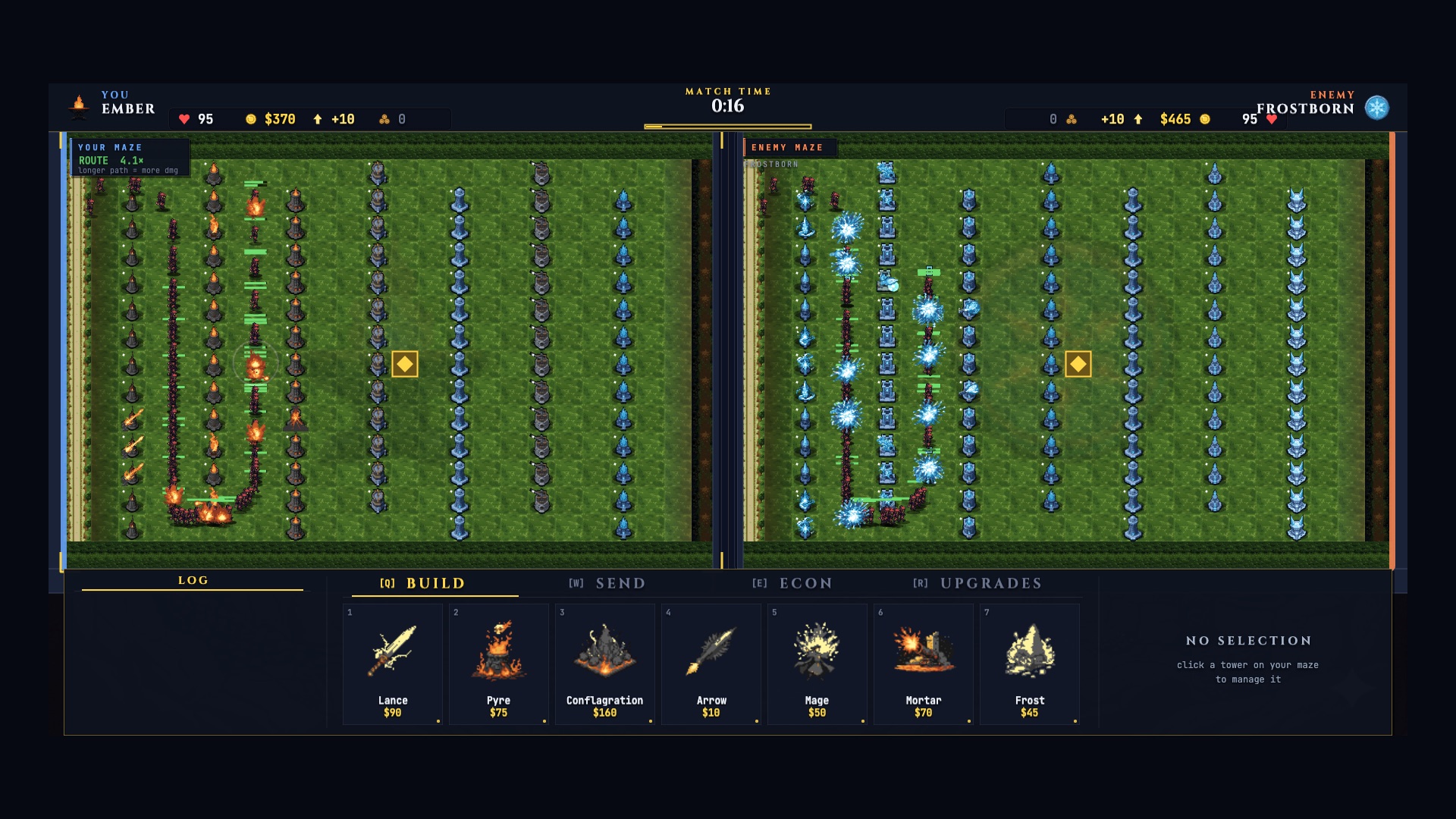
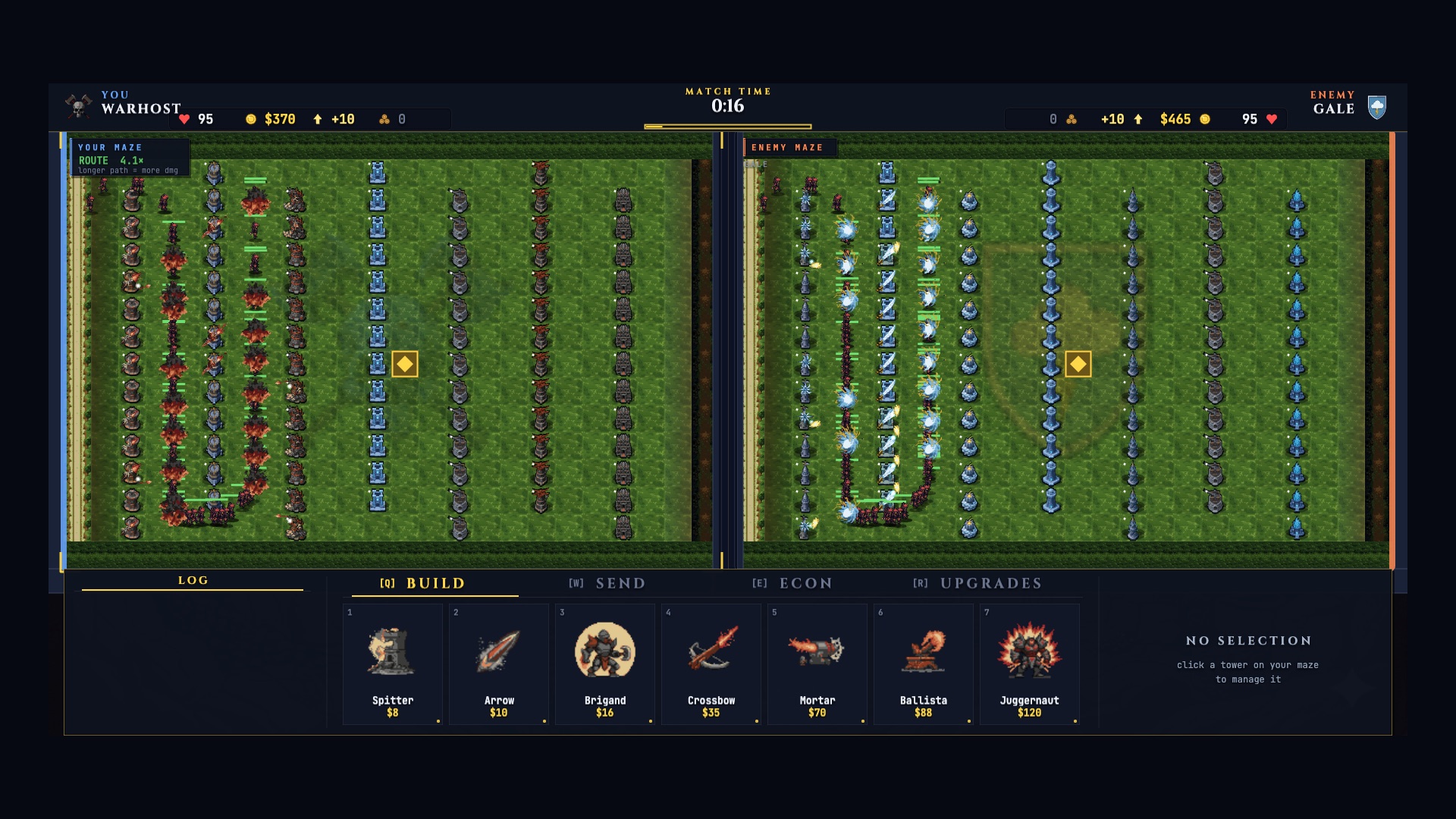
This is the branch nobody writes about, which is strange, because it is the most prolific one. The World Editor was a tower-defense factory. Every server had a dozen TD lobbies open at any hour: Green TD, Gem TD, Wintermaul, Element TD, Line Tower Wars, Legion TD, and a hundred forks of each. Some were solo survival maps. The interesting ones were tower wars: two or more players each defending a lane, racing an income economy, and sending creeps at each other to force a leak. That versus loop, mazing on your side while pressuring the other, is the specific thing this site is built around, so I care about this branch most.
Element TD to Element TD 2
Element TD was a WC3 tower-defense map built around a clever hook: towers were made from six elements, and combining them unlocked dual-element towers with new effects. It was one of the most played TD maps of its era and spread across the SC2 arcade later too. In 2020 its creator shipped a real standalone, Element TD 2, on Steam, keeping the element-combining core intact and expanding it. It later added a Mazing Expansion that sold the free-placement style of the original back as content. This is a clean success: same designer, same core, rebuilt for its own platform, still updated. If you played the map, the sequel feels like the map with a budget.
Legion TD to Squadron TD to Legion TD 2
Legion TD is the most interesting case history in the whole branch because you can watch the idea hop engines. The original was a WC3 map where you build fighters that auto-battle waves and send units to pressure your opponent, no mazing, a fixed lane. When Blizzard shipped StarCraft 2 with its own arcade, the team rebuilt Legion TD there as Squadron TD, which became one of the most-played maps in that arcade for years. Then AutoAttack Games took the concept fully standalone with Legion TD 2 (Steam, 2017 in early access), a paid multiplayer TD that, as PC Gamer put it, brought the mod back "after 12 years." It still sustains a healthy concurrent player base and a relentless balance-patch cadence. Three engines, one lineage: Warcraft 3, StarCraft 2, then a game of its own.
A popular Warcraft 3 mod returns after 12 years with a standalone sequel.
PC Gamer, on the standalone sequel
Line Tower Wars, and the branches that snapped off
Line Tower Wars (usually just "LTW") was the purest expression of the versus TD: a straight lane, an income economy, and a sending economy where your gold could go into your own towers or into creeps you fling at the enemy lane. It was enormously popular and, unlike Legion TD, it centered the tension between building and sending that defines the subgenre. The obvious question is why LTW never got the clean standalone that Element TD and Legion TD did.
There were attempts near the tower-wars space. Tower Wars (2012) was a standalone multiplayer TD on Steam explicitly in this family, build a maze, send creeps, break the other player. It launched to a modest reception and did not hold a community. Within a couple of years the lobbies were empty and it drifted into the long tail of dead multiplayer games. Unleashed and other tower-wars-styled indies circled the same idea and met similar fates. The post-mortem is not mysterious: a versus game lives or dies on population. If your matchmaking pool is a few hundred people on a paid client, a quiet week becomes a dead one, and a dead one becomes a refund. The WC3 originals never had this problem because they borrowed Warcraft 3's entire player base and its free custom lobby. Cut that cord and you have to grow a crowd from zero, on your own storefront, competing for attention with everything else on Steam. Most could not.
Gem TD and the solo survivors
Not every branch was versus. Gem TD was a beloved solo maze-TD where towers were random gems you combined and had to route creeps around a shifting board. It never got a direct branded standalone, but its DNA (random draws, combine-to-upgrade, mazing under randomness) is visible in a whole shelf of Steam maze-TDs that followed. Some ideas do not need a sequel with the same name to survive. They just need enough designers who loved the map to keep rebuilding its best mechanic under new titles.
#Auto Chess, or how the editor minted a second genre
If you thought the World Editor was finished producing genres, it minted another one a decade after DotA. In early 2019 a Dota 2 custom map (Dota 2 shipped with its own Workshop and a scripting layer descended from the same modding culture) called Dota Auto Chess exploded. The pitch: draw units from a shared pool, place them on a board, and let them auto-battle; combine duplicates to upgrade, chase unit synergies, and survive a lobby of eight players. It was, once again, a small team building on a first-party engine's mod tools, and it became a phenomenon within weeks.
The standalone rush that followed was immediate and crowded. The original team took it to its own client as Auto Chess. Valve shipped its own take, Dota Underlords. Riot folded the format into League as Teamfight Tactics. A whole genre, the auto-battler, was named and populated inside a single year off the back of one mod. That is the second time in this article a custom map on a Blizzard-or-Valve engine did not just spawn a game, it spawned a category. The World Editor's culture, the assumption that you can and should reprogram someone else's game into a new one, kept paying out long after Warcraft 3 itself was legacy software.
#What survives the jump, and what kills it
Line up the winners and the casualties and the pattern is not subtle. It comes down to three things a standalone either keeps or breaks.
The ones that survived kept the core loop untouched. Dota 2 is DotA. Element TD 2 is Element TD with room to grow. Legion TD 2 is Legion TD's auto-battling send economy, rebuilt but recognizable. None of them "reimagined" the thing people loved. They shipped the exact loop the map had proven, then added around the edges. The map already did the hard design work over years of public playtesting with thousands of lobbies. The smart move was to trust it.
They rebuilt the community deliberately. A versus game is its population. The survivors treated audience as the actual product: Riot and Valve had reach to spare, and AutoAttack Games grew Legion TD 2's crowd patiently and kept them with constant balance patches. The maps that died as standalones usually died of loneliness, not bad design.
And they stayed accessible. The magic of the original experience was a click in a lobby list, free, no install beyond a game you already owned. Every friction a standalone adds (a price tag, a launcher, a download, an account wall) taxes the exact impulse that made the map spread. It is not that paid or downloaded games cannot work. It is that a niche versus game with a small pool cannot afford to also split that pool behind a paywall or a 4 GB install. The projects that faded, Tower Wars and its cousins, tended to do all three at once: they added friction, they launched to a base too small to split, and they charged up front for a genre whose whole heritage was free.
#The maps that never made the jump
Which brings us to the branch that mostly never got translated at all: the mazing tower-wars maps. Legion TD went standalone but it has no mazing, its lane is fixed. Element TD 2 has mazing but is primarily a solo experience. The specific combination that defined the most-loved versus TD maps, free placement mazing plus creep-sending against a live opponent, is exactly the thing none of the big standalones carried across intact.
The clearest example is Wintermaul Wars. It was the canonical mazing tower-wars map: build your maze anywhere on an open field to stretch the creeps' path, run an income economy, and send waves at the other player to force a leak while defending your own board. It had a real competitive scene and years of version refinement, and it never once ran outside Warcraft 3. There is no Wintermaul Wars 2 on Steam. There is no first-party remake. For a map that arguably defined its subgenre, it sits in the odd position of being historically important and completely untranslated. I wrote a full history of it here if you want the version lineage and how to still play it in 2026: the history of Wintermaul Wars.
Not every branch of this tree needs to end in a billion-dollar company. Most of the interesting ones did not. What the World Editor really proved is smaller and more durable than DotA's money: that a good core loop, discovered by strangers in a lobby, is worth carrying forward, and that the loops still waiting for a proper standalone are the most interesting place a designer can point. The mazing tower-wars branch is still open. That is the whole reason we are here.